> ## Documentation Index
> Fetch the complete documentation index at: https://checkly-422f444a-mda-troubleshooting-section.mintlify.site/llms.txt
> Use this file to discover all available pages before exploring further.
# What is Checkly?
> The Application Reliability Platform built for modern engineering teams.
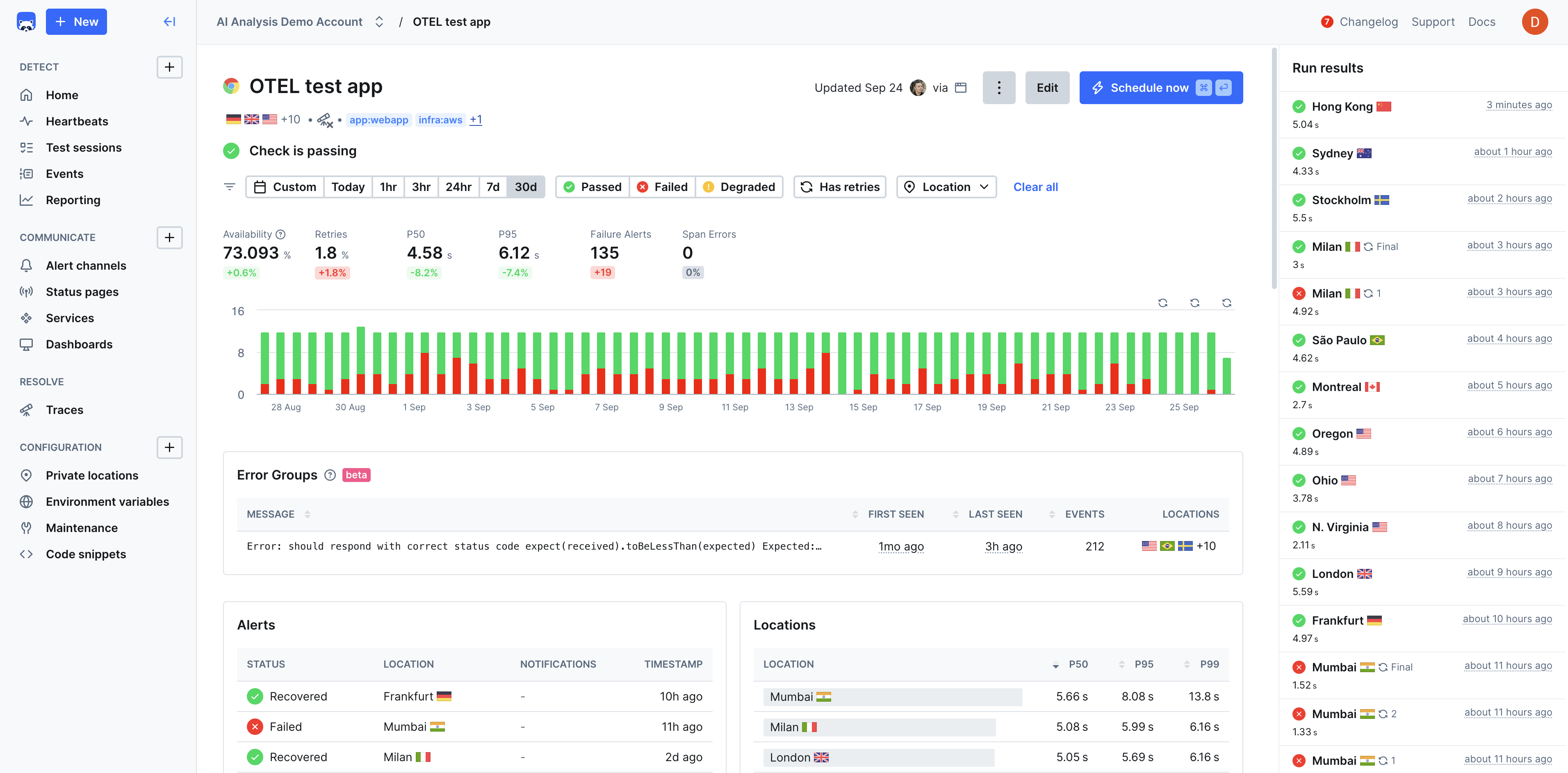
Checkly is a Application Reliability platform that enables teams to **test, monitor, and observe** their web applications, APIs, and other services in a unified workflow. Built for modern development teams, Checkly uses [Monitoring as Code](/guides/getting-started-with-monitoring-as-code) to help define your monitoring setup in code and integrate directly into CI/CD pipelines. Rely on a single workflow to define your monitoring in code, automatically test it in preview environments and deploy with your production code.
**The platform combines three core reliability capabilities:**
Testing, Uptime Monitoring, and Synthetic Monitoring with Playwright.
Customizable Alerting, Dashboards, & Status Pages for clear communication.
Distributed full-stack tracing and AI-powered incident analysis and context.
## Why Checkly?
Checkly helps developers increase uptime and reliability, improve shipping velocity, and improve incident response time through a unified workflow that's scalable, automated, and AI-ready. Teams most often choose Checkly for:
Instead of monitoring being configured through a bulky, limited UI that is slow to keep up with the pace of development, Checkly enables engineers to build and configure their entire monitoring process with Typescript constructs.
Checkly's browser monitoring is powered natively by Playwright, the world's most popular open-source testing framework. It's fast, robust, reliable, and enables engineers to easily build tests that can monitor fully replicated end-to-end scenarios.
Checkly is a code-driven platform with all the constructs, APIs, and integrations that your engineering team needs to automate & program their entire observability process. The Checkly CLI manages the entire lifecycle of your monitors.
Checkly proactively improves application reliability by unifying testing, monitoring, and observability into a single workflow using technologies like Playwright and Open Telemetry.
Checkly accurately detects both **functional** and **performance errors** in pre-production and production environments. This helps consolidate tooling and improving the velocity of teams shipping quality features and services.
## Use Cases
Validate application functionality and performance in staging environments before deployment, catching regressions early in the development cycle.
[Learn more](/guides/sdlc-monitoring)
Continuously monitor critical user journeys, API endpoints, and application performance to ensure optimal user experience.
[Learn more](/learn/monitoring/api-monitoring)
Monitor checkout flows, payment processing, and product catalog functionality to prevent revenue loss from broken user paths.
[Learn more](/guides/monitoring-ecommerce-apps-using-playwright)
Ensure third-party integrations and internal APIs maintain expected response times and availability through automated testing.
[Learn more](/learn/monitoring/api-monitoring)
Test applications across different environments, browsers, and devices to ensure consistent functionality and performance.
[Learn more](/concepts/environments)
Track uptime and performance metrics to meet service level agreements and regulatory compliance requirements.
[Learn more](/learn/incidents/slo-sla-sli)
## Checkly Is Best Fit For
**DevOps and SRE Teams** looking for programmable monitoring that integrates seamlessly with their existing infrastructure-as-code and GitOps workflows.
**Full-Stack Engineering Teams** who want to shift monitoring left and treat monitoring as an integral part of their development process rather than an afterthought.
**Engineering Teams Using Modern Web Technologies** who want monitoring that understands modern JavaScript frameworks, SPAs, and API-first architectures.